
ISPM 15 Pallet Requirements for Australia: What Exporters Need to Know
June 9, 2026
Top 5 Hardwood Types Used in Pallet Manufacturing
June 23, 2026
ISPM 15 Pallet Requirements for China: What Exporters Must Know
A missing IPPC stamp can stop a shipment worth millions at a Chinese port. In 2024, Shenzhen Customs detained imported equipment worth more than 5 million yuan. The wooden pallets had no IPPC mark. The goods were destroyed. The shipper paid an extra 120,000 yuan in processing fees.
That outcome is preventable. China enforces ISPM 15 at every major port, and the rules are specific. Three bodies are responsible for phytosanitary compliance in China. Three agencies oversee this process: MARA (Ministry of Agriculture and Rural Affairs), GACC (General Administration of Customs of China), and NFGA (National Forestry and Grassland Administration).
GACC handles entry-exit inspection and quarantine at the border. Their contact point for wood packaging non-compliance is listed on China’s National Plant Protection Organisations on the IPPC portal.
Why China Takes ISPM 15 Seriously
China is one of the world’s largest import markets. Large amounts of wooden packaging cross the border every day. This creates an ongoing biosecurity risk.
China conducts frequent physical inspections of imported wood packaging material. Non-compliant WPM is often destroyed or re-exported at the shipper’s expense.
China also requires wood packaging manufacturers to be registered. This rule goes beyond the basic ISPM 15 standard. Chinese ports enforce this rule.
GACC has also introduced electronic mark verification for some trading partners. Officials can use this system to confirm that a manufacturer’s CN code is registered.
There is no tolerance for unclear, faded, or missing stamps.
Which Pallets Need Treatment for China Shipments
The standard applies to all solid wood. All solid wood packaging used for international shipments must follow ISPM 15. This includes pallets, crates, dunnage, and cable reels.
Exemptions apply to:
-
Plywood, MDF, particleboard, and oriented strand board
-
Wood packaging 6mm or less in thickness
-
Plastic, metal, and composite pallets
If your supplier uses a solid wood pallet, even just one in a container, it must be treated and have a valid stamp. The most common mistake suppliers make is choosing the wrong material. To avoid biosecurity risks, ask your supplier to use only plywood or plastic pallets.
Approved Treatment Methods
Two methods are accepted under ISPM 15 for China-bound shipments.
Heat treatment (HT) is the standard globally and in China. The wood must reach a core temperature of 56°C for a least of 30 continuous minutes. HT is the standard treatment method used and accepted by major markets around the world. It is chemical-free and environmentally clean.
Methyl bromide fumigation (MB) remains accepted in China. MB is often used for urgent shipments. However, many countries are reducing or restricting its use due to environmental concerns.
All treated wood must also be debarked before treatment. If solid wood packaging is more than 6 mm thick, it must be treated, debarked, and carry an official IPPC stamp. The treatment can be heat treatment or methyl bromide fumigation.
Reading the IPPC Stamp for China
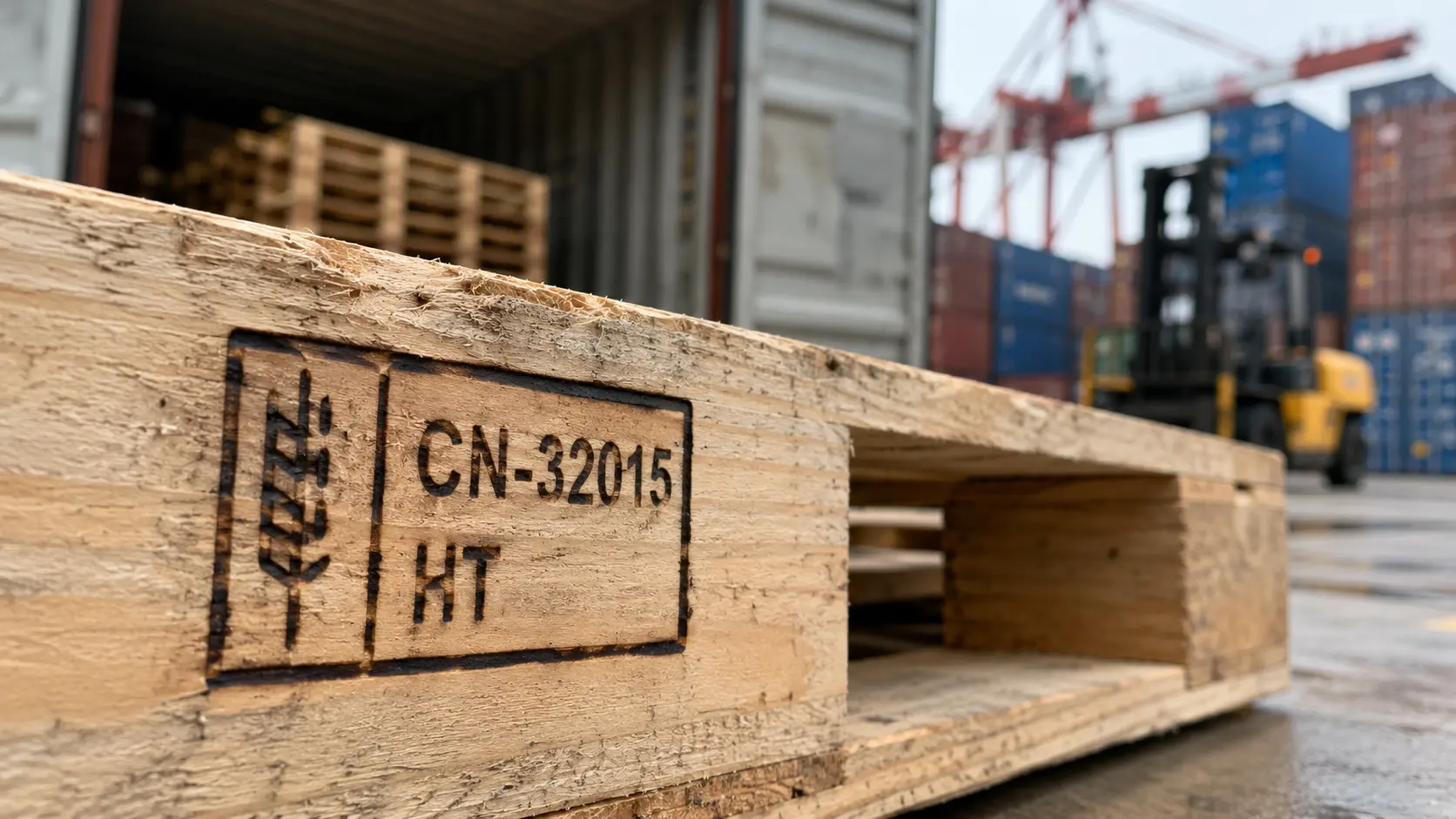
Every compliant pallet entering China must carry a correctly formatted IPPC mark. The stamp must show the IPPC wheat logo, the country code, a unique producer code, and the treatment code. For China-made pallets, the country code is CN. The treatment code is HT or MB.
The mark must appear on two opposite sides of the pallet. It must be burned or branded into the wood not printed in ink. A stamp that is faded, partial, or printed rather than branded is non-compliant.
Marks must not use red or orange colours, as these are reserved for hazardous materials. DAFF
Knowing how to read a legitimate stamp also protects your inbound supply chain. The same principles apply when you need to verify an IPPC stamp on any pallet arriving at your warehouse.
China’s Manufacturer Registration Need
This is where China differs from most markets.
The CN code on an IPPC stamp must be linked to a registered manufacturer in China. GACC’s verification system helps customs officers confirm this.
The stamp must be linked to an active, registered code. If the code is missing or suspended, the stamp will fail verification even if it looks genuine. Always confirm your supplier’s registration status before loading.
This applies equally when exporting from China. The facility that produces or treats the pallets must have a valid registration. Applying a code alone is not enough. For a broader compliance comparison, see our guide on ISPM 15 requirements for Australia.
What Happens When Pallets Fail Chinese Customs
The outcomes are swift and costly. A 2024 case reported by Shenzhen Customs shows the risks of non-compliance. Problems with the wooden packaging led to the detention and destruction of imported equipment worth over 5 million yuan. The shipper paid an more 120,000 yuan in processing fees.
If pallets fail inspection at a Chinese port, customs may destroy them, send them back, or hold them. China conducts regular inspections. Wood packaging that does not meet the requirements is often destroyed or returned. Fixing the issue after an order is issued is usually not possible.
Documentation matters too. Keep treatment certificates, facility registration numbers, and packing declarations with every consignment.
Start With Compliant Pallets
If you export to China often, use verified ISPM 15 suppliers to avoid problems at the port. Skylar Impex supplies ISPM 15-compliant pallets for exports to China. The pallets meet key export requirements. They are heat treated, correctly stamped, and include the required documents.
The Bottom Line
China applies ISPM 15 rules rigorously. China also requires manufacturers of wood packaging to register. This rule does not apply in many other countries. Solid wood pallets need proper treatment, a valid stamp, and a registered manufacturer. Get any one of these wrong and the shipment stops and the costs land entirely on the exporter.
Check that your supplier is registered. Verify each stamp before loading. Keep the required documents with every shipment.
FAQ
What does the CN code on an IPPC stamp mean?
CN is the ISO country code for China. It shows that the pallet was treated and stamped by a registered facility in China. The code must be traceable to an active manufacturer registration.
Does China must manufacturer registration for ISPM 15?
Yes. China requires registration of manufacturers of wood packaging material. This is a China-specific need beyond the baseline ISPM 15 standard. An unregistered manufacturer’s stamp will not clear GACC inspection.
Are plywood pallets exempt from ISPM 15 in China?
Yes. Plywood, MDF, particleboard, and other processed wood products are exempt. Plastic and metal pallets are also exempt. Only solid timber thicker than 6mm requires ISPM 15 treatment.
Can repaired pallets be used for China shipments?
A repaired pallet can be used only if pre-treated wood was used and the original stamp is still clear and readable. If new solid wood parts are added, the pallet must be treated and stamped again. Any modification with untreated wood invalidates the certification.