
How EPAL Standards Support Sustainable Logistics
November 17, 2026
How EPAL Pallets Perform in Extreme Weather Conditions
November 27, 2026

A real EPAL pallet tells you a lot before you lift it. Every block carries a stamp, a code, or a nail that means something. Here’s a plain guide to EPAL pallet markings and codes.
 Some marks come from EPAL. Others come from the ISPM 15 standard, the global rule for wood packaging. Once you know which is which, a check takes about a minute.
Let’s walk around the pallet, one block at a time.
Where to find EPAL pallet markings and codes
Most marks sit on the blocks, not on the boards. Corner blocks hold the logo. Middle blocks hold the treatment mark, the codes, and the staple.
So stand at the long side of the pallet. Start at a corner and work toward the middle. A standard EPAL pallet has nine blocks, so you won’t search long.
The EPAL logo
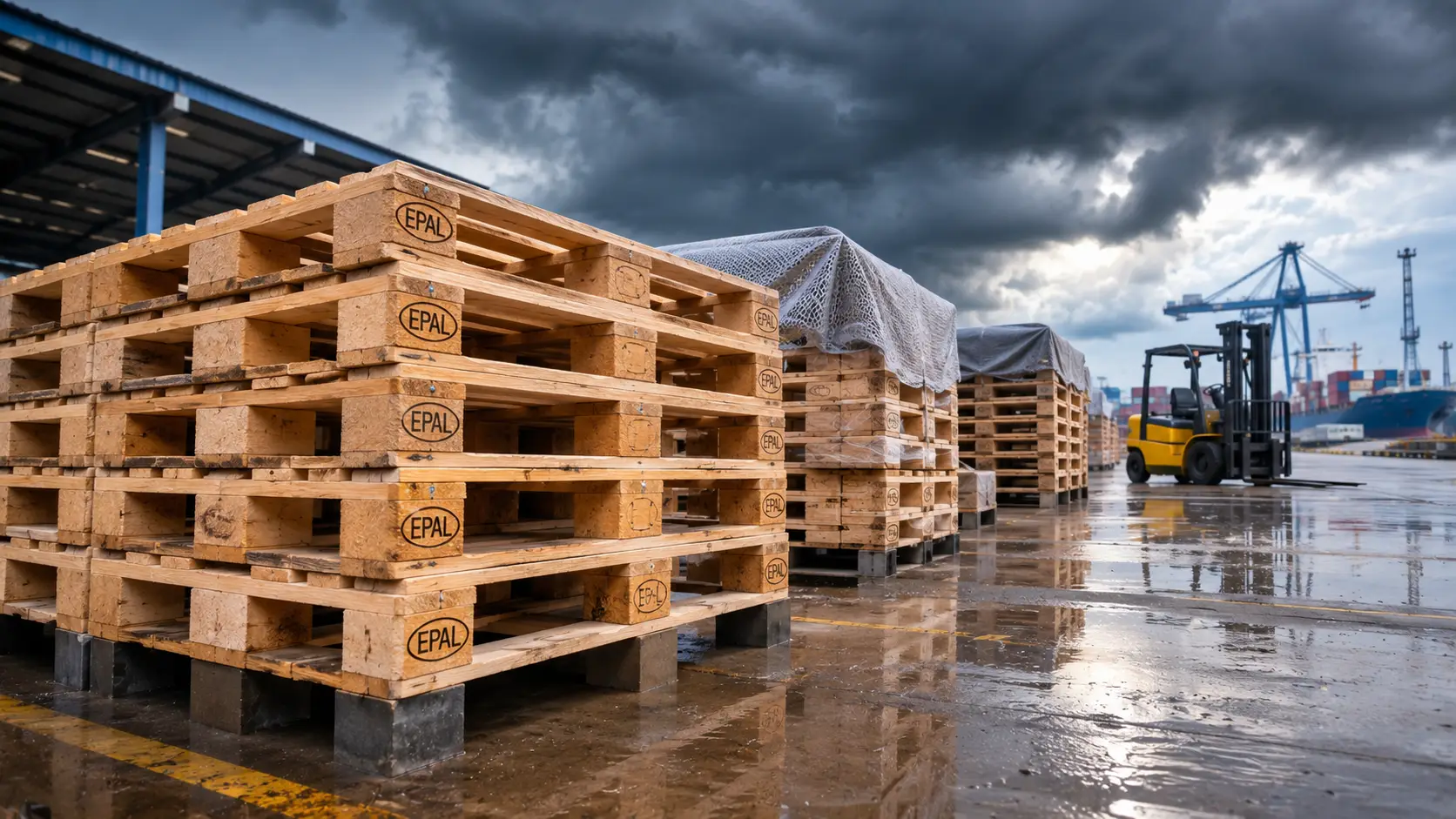
The “EPAL in oval” logo is a trademark. Only licensed companies may use it.
EPAL brands it on all four corner blocks. It has done so since 1 August 2013. If a corner block has no logo on a new pallet, ask the supplier why.
The licence number, year, and month
Look just below the IPPC mark. You’ll see the maker’s licence number, then the year and month of production.
The licence number names the licensed company that built the pallet. If a load goes wrong, you know who to call.
Here’s a habit that helps. Snap a photo of this block on each delivery. If a claim comes up later, you have proof of where the pallet came from.
The IPPC mark
This mark isn’t EPAL’s. It proves the wood got ISPM 15 treatment. EPAL has required it on its pallets since 1 January 2010.
The mark has four parts:
- The IPPC symbol, a wheat ear
- A country code, like IN for India
- A producer code, which is the plant protection registration number
- A treatment code, which is HT for heat treatment on EPAL pallets
The mark must be legible. It must never be hand drawn.
Say you export from Mumbai to Hamburg. An inspector looks for the country code and the HT code first.
Want the full export picture? Read our guide on ISPM 15 complianc
The control staple
New EPAL pallets carry one control staple on a middle block. EPAL calls it forgery-proof. It shows an independent quality check took place.
The staple is yellow or black and shows the “EPAL in oval” mark. Fake pallets usually lack it.
Nails with two letters
A standard EPAL pallet has 78 nails. Each approved nail has two letters on its head.
Check a few heads. All 78 nails should carry the letters, so plain nails are a warning sign.
The repair nail
A repaired pallet gets a repair nail on a middle block. It shows the EPAL logo and the repairer’s licence number.
Only licensed repair shops may fix EPAL pallets. A patched pallet with no repair nail breaks the rules.
The QR code and serial number
Newer pallets carry a QR code on a corner block. Beside it is a nine-character serial number.
The serial number is unique. A scanner or a person can read it. So you can link a pallet to the goods on it.
Not every EPAL pallet has a QR code yet. Don’t reject a pallet only for that.
A 60-second check at the dock
Say a truck brings 200 pallets to your Pune warehouse. Pull ten and check these:
- EPAL logo on all four corner blocks
- Control staple on a middle block
- IPPC mark with HT on the middle blocks
- Licence number, year, and month below it
- Two letters on the nail heads
- A price that fits the market
Prices far below market are a red flag. EPAL says such offers are almost always fake. Our guide on how to spot fake EPAL pallets goes deeper.
What markings can’t tell you
Marks show how a pallet was built and treated. They don’t show damage.
A standard EPAL pallet measures 1,200 x 800 mm and weighs about 25 kg. Its safe working load is 1,500 kg. A cracked board can change that fast.
So also check for cracked boards, loose nails, and mould. A good stamp on a broken pallet is still a broken pallet.
Quick answers to common questions
Is the IPPC mark an EPAL mark?
No. It comes from ISPM 15. EPAL requires it on its pallets.
Where is the control staple?
It sits on one middle block of a new pallet.
Who can repair an EPAL pallet?
Only licensed EPAL repairers. Look for the repair nail.
What do the letters on the nails mean?
They mark the nail as EPAL approved. Look for two letters on each head.
Need EPAL pallets with clear markings?
Shipping soon? Clean, legible marks save time at the port and the dock.
Check our EPAL pallets manufacturer page. Or tell us your load, and we’ll help you pick the right pallet.
Read the marks before you trust the pallet
EPAL pallet markings and codes take a minute to read. They tell you who built the pallet, how the wood got treated, and whether someone repaired it.
Learn the blocks once. Then every delivery gets easier to check.