
Pallets in the Automotive Parts Industry
September 21, 2026
Top 10 Questions to Ask Before Buying Pallets
October 5, 2026
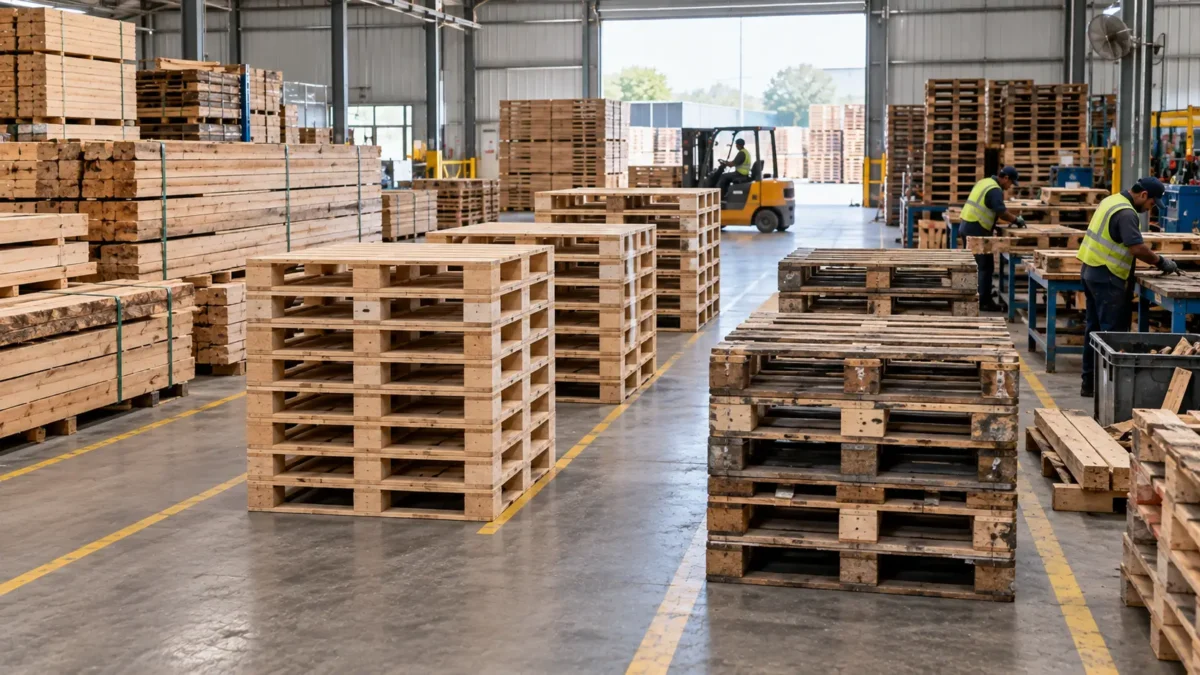
The Lifecycle of a Wooden Pallet
A pallet’s job doesn’t end when a shipment arrives. For most wooden pallets, delivery is just the first stop on a much longer journey.
 Research on wooden pallets found that most pallets are used for about 20 shipping cycles. After that, they are retired. Some last as few as 5. Others stretch past 30. That range depends entirely on how the pallet gets built, used, and maintained along the way.
Stage One: Raw Material
Every pallet starts as timber. Pine and spruce are common softwood choices. They grow fast and are easy to source from managed forests.
The wood gets cut, kiln-dried to control moisture content, and cut into boards and blocks. This drying step matters more than it seems. Wood dried to the wrong moisture level warps faster and fails sooner once it’s in service.
Stage Two: Manufacturing
Boards and blocks come together into a finished pallet. Nail patterns, board thickness, and block spacing depend on how the pallet will be used. The design can vary for GMA, EPAL, or CP pallets.
If the pallet is headed for export, this is also where ISPM 15 heat treatment happens. The wood gets heated to kill pests, then stamped with an official mark before it ever gets used.
Stage Three: First Use
The pallet is used for the first time. It carries a load from the warehouse to the truck and then to its destination. This single trip is often what people picture when they think about a pallet’s job.
But for a well-built, properly maintained pallet, this is only the beginning. One trip represents a small fraction of the pallet’s total working life.
Stage Four: Repeated Cycles and Repair
This is where the real value of a wooden pallet gets built. Each shipping cycle adds wear, cracked boards, loosened blocks, worn corners. Left unaddressed, this damage eventually takes a pallet out of service.
Repair extends this stage significantly. A damaged pallet doesn’t have to retire after one bad trip. Licensed repair centers replace weak boards and damaged blocks. This helps return the pallet to service with almost the same strength as before.
The EPAL exchange pool keeps pallets in use for years. This shows how repairs can extend a pallet’s working life. Repair cycles happen roughly every 7 to 12 trips in well-run systems, based on industry data.
Stage Five: Assessing the Damage
Not every pallet is worth repairing forever. At some point, the cost of another repair exceeds the value of keeping the pallet in service.
This decision usually comes down to structural damage versus cosmetic wear. A cracked deck board is an easy fix. A split stringer or badly damaged block can mean the pallet is near the end of its useful life.
Stage Six: End of Life
Eventually, every pallet reaches a point where repair no longer makes sense. But retirement doesn’t mean the material goes to waste.
When a pallet reaches the end of its useful life, the wood is often reused for other purposes. Retired pallets commonly become mulch, particleboard, or biomass fuel. The carbon stored in the wood stays in productive use, even after the pallet itself is gone.
What Determines How Long a Pallet Lasts
A few factors decide where a specific pallet falls in that 5 to 30 cycle range. Wood species matters, with denser hardwoods generally outlasting softwood under repeated stress.
Handling conditions matter just as much. Rough forklift use, heavy loads, and moisture can shorten a pallet’s working life. Poor drying can also cause problems. A well-built pallet handled carefully can significantly outperform the average.
Reuse and repair systems can extend a pallet’s life. They work better than using a pallet only once. Pallets built for exchange pools are designed with this longer life in mind from the start.
Getting More Life Out of Your Pallets
If you manage many pallets, track how many cycles each pallet completes. This shows if you are getting full value from each pallet or replacing them too soon.
Choose a supplier that builds durable pallets and supports repairs. This can save money over the pallet’s full working life, not just its first use.
Conclusion
A wooden pallet’s life doesn’t end at delivery. A well-managed pallet can complete 20 or more shipping cycles. After that, its materials can be recycled and used for something new.
Need pallets built for a long working life, not just a single trip? Get durable, repair-ready wooden pallets built to get the most out of every cycle.